Oxy Biochemistry Database
A full-stack lab management platform for organizing and tracking biological samples.
Overview
I worked with Professor Vikram in Occidental College’s Biochemistry Department to design and build a centralized system for tracking laboratory strains. The department previously relied on inconsistent, handwritten labeling and scattered spreadsheets, making it difficult for faculty to locate, share, or catalog samples. I contributed to the UI/UX design, frontend structure, and project documentation, collaborating with teammates who developed the backend and database schema.
Problem
- No centralized inventory system for strains
- Tubes stored across multiple labs with inconsistent labeling
- No way to quickly locate a sample’s room, freezer, shelf, rack, or box
- No barcode or ID system for fast retrieval
- Professors used different organizational methods, causing confusion
My Role
- Designed core wireframes in Figma for search, detail, and add/edit flows
- Chose typography, color palette, and layout based on Oxy’s design system
- Implemented key parts of the React frontend
- Collaborated with backend teammates on API structure and data flow
- Wrote documentation summarizing system architecture and user flows
Design & User Flow
Search
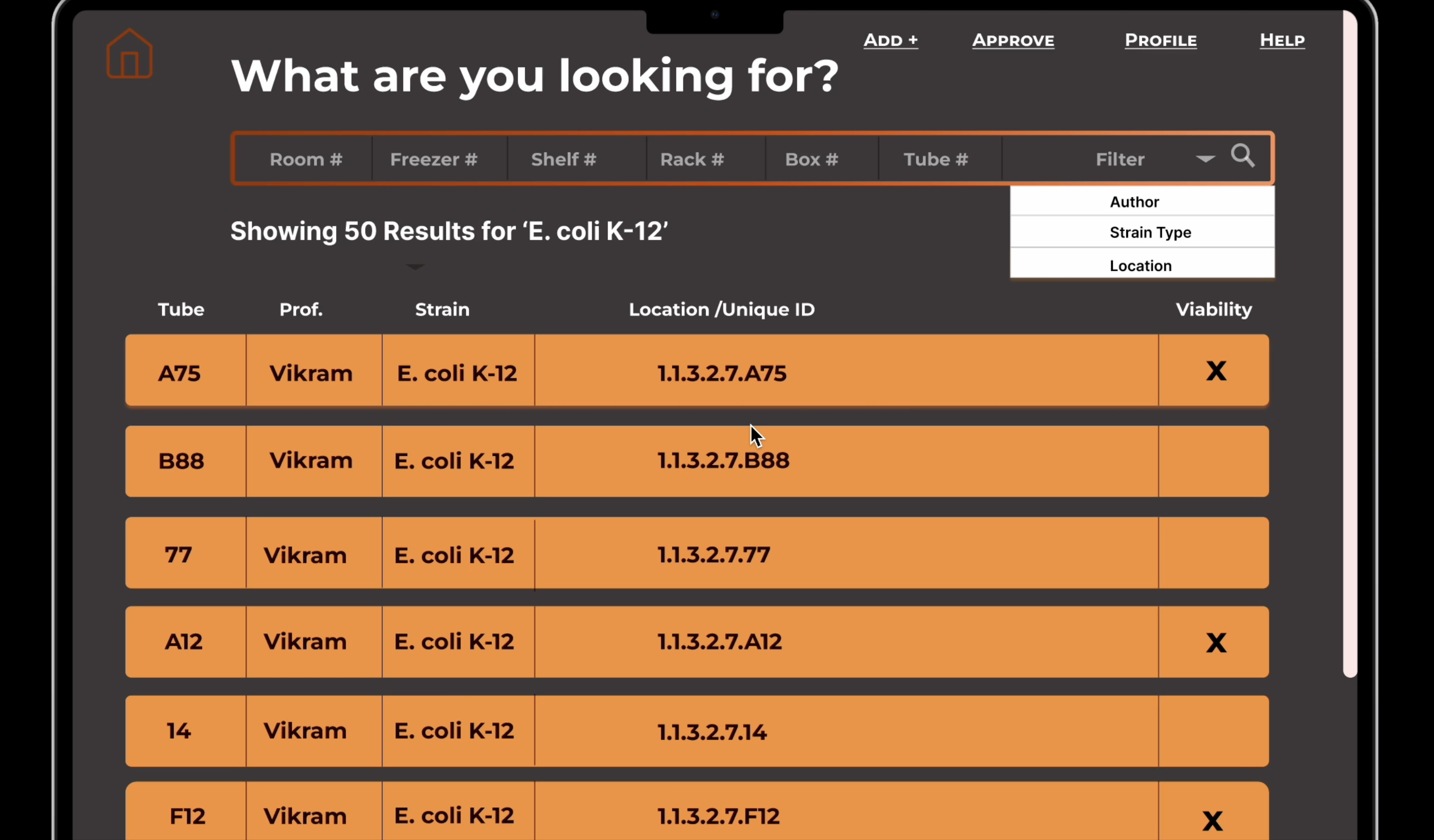
- General search across all fields
- Location-based search mirroring Room → Freezer → Shelf → Rack → Box → Tube
- Filter search by professor, marker, date, etc.
- “View All” option for full inventory visibility
Sample Detail Page
- Shows tube label, sample name, professor, markers, organism type, and notes
- Buttons to edit, delete, and generate a barcode
Add & Edit Samples
- Structured inputs to reduce errors and enforce the storage hierarchy
- Checks for conflicts when a tube location is already occupied
Admin Dashboard
- Allows professors to add rooms, freezers, shelves, racks, and boxes
Technical Overview
Frontend
- React.js UI with multi-field search and detail views
- Responsive layout for lab use on different devices
Backend
- Node.js + Express.js REST API
- Validation, error handling, and CORS for frontend integration
- Environment variables for secure database configuration
Database
- MySQL hosted on AWS RDS
- Hierarchical schema: Room → Freezer → Shelf → Rack → Box → Tube
- Centralized unique ID system used for barcode generation
Reflection
This project taught me how to design for a highly technical scientific audience and collaborate across a frontend/backend split. It pushed me to think about real-world constraints like mobile usability, data integrity, and user error prevention. If I continued the project, I’d focus on improving mobile layouts, expanding user personalization, and integrating batch barcode scanning for faster inventory management.